 Learning American Sign Language. Learning American Sign Language.
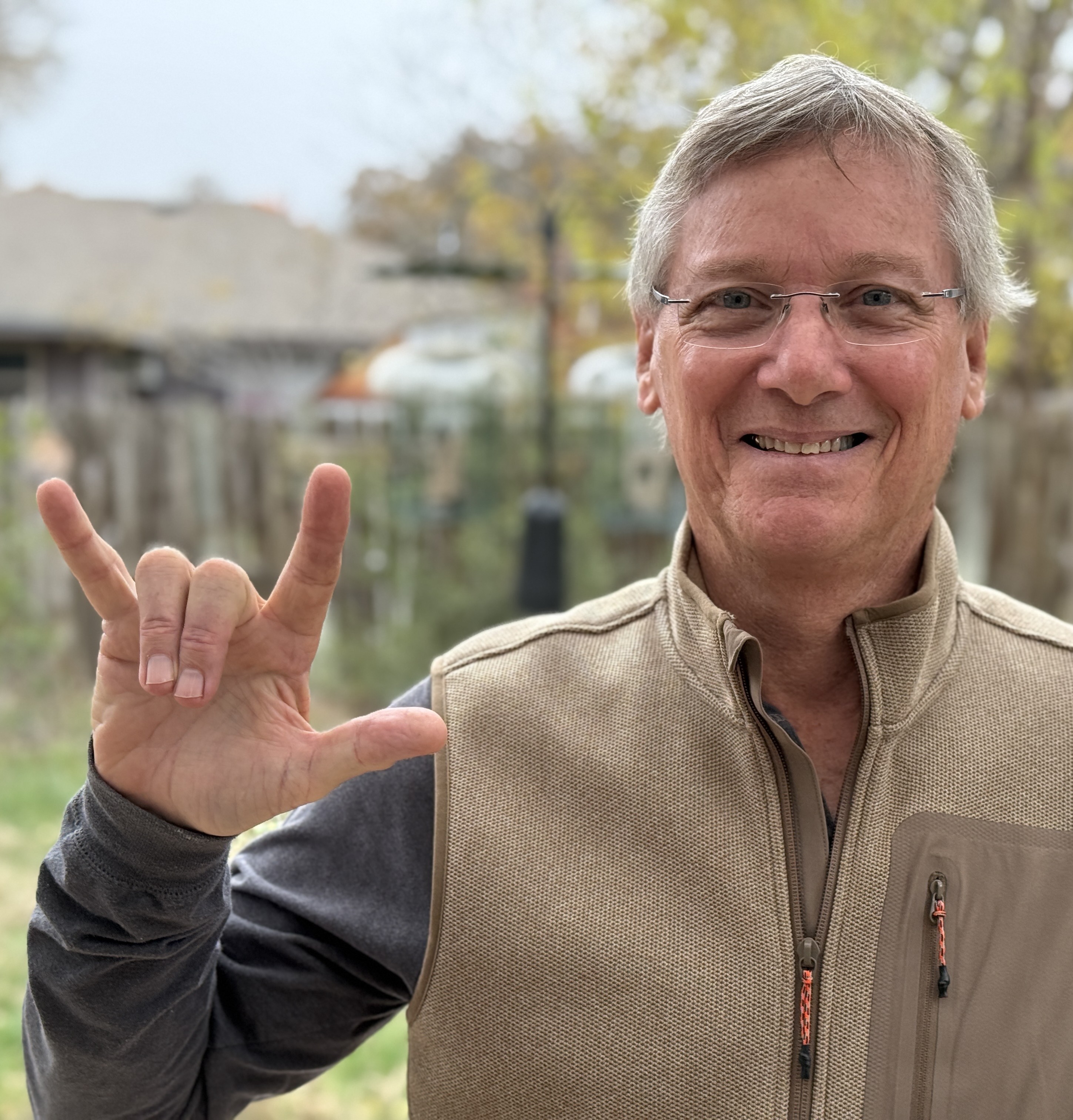
I’m learning American Sign Language. I’m telling you that because if you were watching me, you might wonder what’s wrong and refer me to a neurologist or a rheumatologist.
This started a few years ago when I decided to learn a new language because, you know, that’s what lifelong learners sometimes do. I did a little research and discovered that ASL is the third most common language used in the U.S. after English and Spanish. Since I already speak those, I figured, “If I’m going to learn a new language, why not the next most popular? It’ll give me so many more opportunities to look foolish in public.”
As usual, I got all excited and signed up for an online course and worked hard at it for a few weeks. Then I got discouraged by the fact that learning a language–any language–by yourself is a little like learning to play badminton by yourself. It’s not that much fun.
I did try signing in front of a mirror long enough to wonder, “If you sign in front of a mirror, is that the ASL way to talk to yourself? Or is it more like an ASL echo?” And what if it’s a hall of mirrors? Reverb?
So then this fall, largely because I wanted to learn ASL and I have a squigit of leverage as the director of Lifelong Learners GTX, we recruited a very patient Dave and his very encouraging assistant AnnMarie to teach a 6-week ASL course. Nora and I signed up, so to speak, so we could learn to sign with each other in noisy places or across large rooms. There was this additional motivation of being able to sign secrets in public places, but that’s a little risky because you never know who might be watching. Not that there’s much chance of anyone understanding our signs, including us.
So that was a fun course. We laughed at each other, created new neurons, interacted and generally fulfilled the goals of lifelong learning. Dave and AnnMarie were much more encouraging than we deserved. We learned signs for letters, numbers, colors, relationships, and courtesy, but we learned other things too. Here are eight of them:
ASL is a real language. It’s not like a language. It is a language. Learning it is like learning a… you know… language. It takes a long time and lots of practice and you can’t just fake it. You don’t get to pretend by randomly twisting your fingers and waggling your wrists. If you’re doing it wrong, it doesn’t help to just shout. Shouting, BTW, means jerking your signs, glaring, puffing out your cheeks and blowing bursts of air.
ASL has pronunciation, although that might not be the right word for it. A wiggle of the finger, a wrongly turned palm, a wisp of a wrist movement in this direction instead of that, and suddenly you are saying something you wish you hadn’t said. Like B instead of 4. In one of my first real-life attempts to sign, I answered a simple yes/no question by enthusiastically signing “chicken.” Now I’m tempted to just keep my hands in my pockets around deaf people, but that’s not how you learn a language. At least not ASL or Italian, neither of which can be properly spoken with your hands in your pockets.
ASL is about more than fingers and hands. It’s amazingly expressive. Faces and posture are as important as what our hands are doing. Eyebrows provide punctation, emphasis, context, intonation and emotion. So do cheeks and lips. So there is the very real possibility I will say one thing with my hands and another with my face. I’m pretty sure my face always says I’m confused or have a headache.
ASL is often the preferred language for bilingual kids. It surprised me that many of them feel able to express themselves most fully using sign language instead of spoken language. I can think of three reasons: 1) they can tell secrets across the room right out in public, 2) they get to act out their emotions in public, 3) it’s their heart language. I’d put my money on 3.
ASL isn’t universal. There are about 300 sign languages in the world with their own vocabularies and grammars. Even England’s is quite different from ours. In spite of there being 35 countries in the Americas, American Sign Language is used in just two: the US and Canada.
Deaf people have a rich culture of their own. If you don’t learn the culture along with the signs, you end up making serious faux pas. I should learn the sign for faux pas. The ASL world is filled with traditions, commonly accepted practices, ways of interacting, and so on. You can’t really embrace the language without embracing the culture.
ASL signers have a refreshing bluntness and sense of humor. They don’t beat around the bush as much, and they laugh often. They enjoy each other. So far my jokes are all unintentional. I can’t wait to understand some of theirs.
ASL is hard, but it’s fun and it opens doors. It’s worth it, and deaf people appreciate our attempts to learn it. So upward and onward.
|